
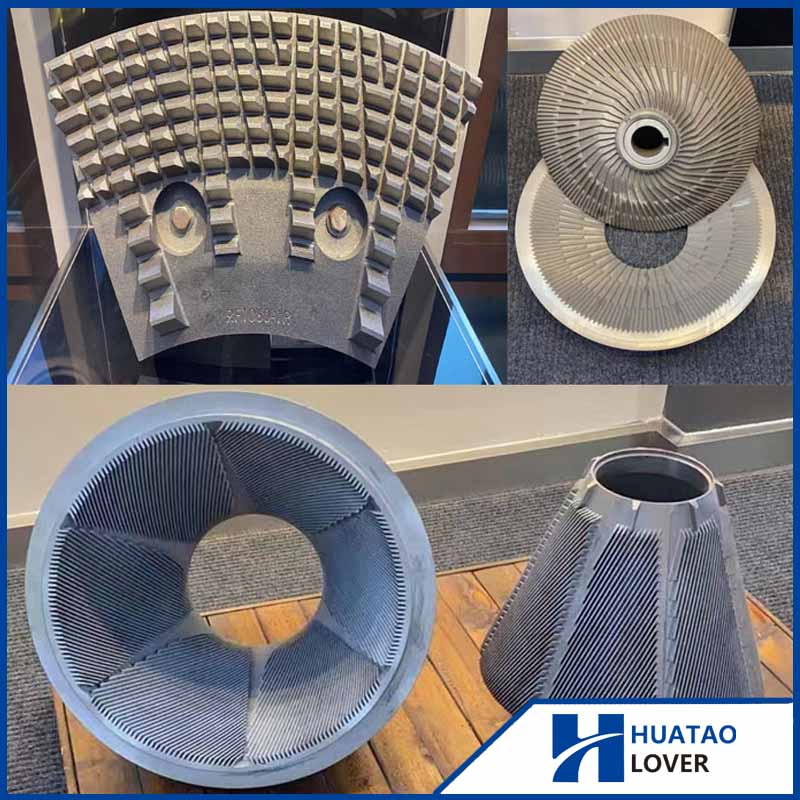
The hot disperser is an important part of many recycled fiber preparation systems.
When a disperser disc becomes seriously worn, the problem may not be immediately recognized as a spare-parts issue. Instead, paper mills may notice declining pulp quality, increased energy consumption, vibration or unstable production.
In many cases, the condition of the hot disperser refiner plate should be included in the troubleshooting process.
Here are seven common problems related to disperser disc wear.
The working teeth of a disperser disc gradually wear during operation.
As the tooth profile changes, the mechanical action applied to the pulp can become less consistent.
Inspect the working teeth and compare their current profile with the original design.
If wear has significantly changed the working geometry, replacement may be more economical than continuing operation.
Recycled pulp may contain ink particles, stickies and other contaminants.
If the disc geometry is severely worn or incorrectly designed, mechanical dispersion may become less effective.
Check:
A replacement plate with a suitable tooth pattern can help restore the intended mechanical action.
An abnormal motor load may have several causes, including incorrect operating conditions, material accumulation or an unsuitable working gap.
A damaged or incorrectly matched disperser plate can also contribute to unstable mechanical resistance.
Inspect the disc surface and installation dimensions before making major process adjustments.
Vibration is another warning sign that should not be ignored.
Possible causes include:
For high-speed equipment, proper manufacturing accuracy and balancing are important.
If a new plate wears out much faster than expected, the problem may not simply be material quality.
The actual cause may involve:
The best solution is to analyze the application before selecting the next replacement plate.
A replacement plate may have the correct nominal diameter but still fail to install properly.
This can happen when the supplier does not accurately match:
For OEM replacement, detailed dimensional verification is essential.
Frequent replacement creates more than a spare-parts cost.
It also creates:
Therefore, paper mills should evaluate the total cost rather than only the purchase price.
A systematic approach can significantly improve replacement results.
Record the disperser manufacturer and machine model.
Check tooth wear, cracks, deformation and mounting condition.
Provide information about pulp type, consistency, temperature and production capacity.
Measure diameter, thickness, mounting holes and other critical dimensions.
Choose the appropriate wear-resistant alloy according to the actual pulp conditions.
Where appropriate, evaluate whether the existing tooth design should be reproduced or improved.
Dimensional and manufacturing inspections should be completed before shipment.
HUATAO supplies customized hot disperser refiner plates for recycled fiber and pulp processing applications.
Our engineering team can support customers with:
Customers can send us a drawing, equipment model or photographs of their existing disperser disc.
We can then evaluate the replacement requirements and recommend a suitable solution.
can not be empty
can not be empty

HUATAO GROUP - REFINER PLATES
ADD : No.298 Zhonghua North Street, Shijiazhuang 050000 China.
TEL : +86 0311 80690567
EMAIL :Lucy.chai@huataogroup.com
Web: www.refinerdisc.com
 WhatsApp & WeChat : +86 15373883537