
Choose fine-bar plates with low specific edge load (0.2–1.0 J/m) for hardwood to preserve short fibers and promote bonding. Choose coarser fillings or reduced bar clearance with higher SEL (1.5–3 J/m) for softwood to develop long fibers without excessive shortening.
Hardwood short fibers need high-frequency, low-intensity refining: fine bars, high bar density, shallow grooves.
Softwood long fibers need controlled fibrillation: coarser fillings, deeper grooves, adequate fiber transport.
A deep-groove plate on hardwood lets short fibers pass unrefined, wasting energy.
Plate hardness alone does not guarantee longer life; alloy toughness and corrosion resistance also matter.
Selection Guide:
Confirm the softwood/hardwood ratio and target freeness (°SR or CSF).
Set SEL: 0.2–1.0 J/m for hardwood, 1.5–3 J/m for softwood.
Match bar width, groove depth, and bar density to fiber length.
Verify refiner model, OEM drawing, and plate dimensions.
Select alloy for wear, toughness, and stock chemistry.
Trial and monitor freeness, fiber length, fines, and specific energy.
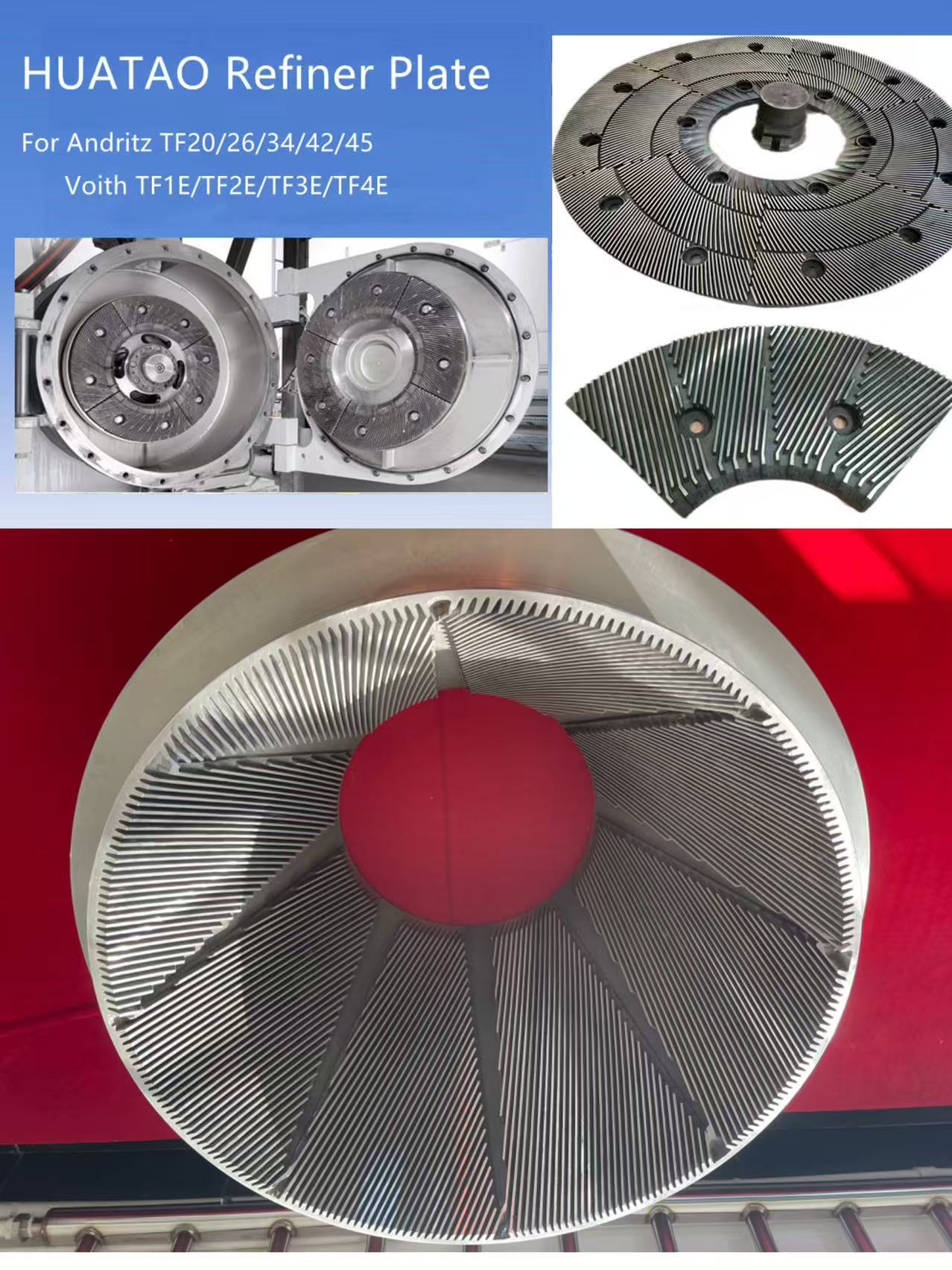
Procurement Checklist: Refiner model, OEM part number, plate OD/ID/thickness, bar and groove dimensions, alloy grade, hardness report, dynamic balancing record, MOQ, lead time, and export packaging.
Failure Analysis:
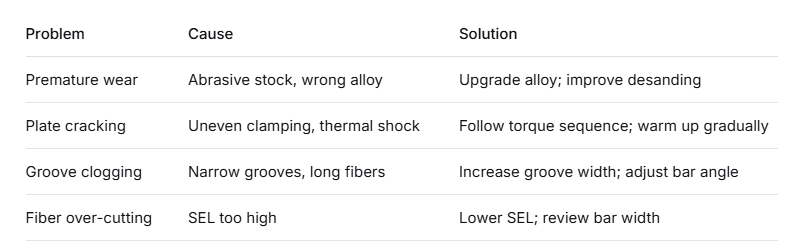
Maintenance: Check pressure, current, and specific energy daily. Measure bar height monthly. Replace segments when bar height drops below 1.5–2.0 mm.
Case Study: A 250,000 t/y fine paper mill split refining into a fine-bar hardwood plate (SEL ≈ 0.6 J/m) and a coarser softwood plate (SEL ≈ 2.0 J/m). Specific energy fell from 28 to 23.5 kWh/t (≈16%), and plate life rose from 55 to 85 days.
FAQ:
Can one plate handle both? Usually not optimally. Separate patterns give better fiber development. See <u>REFINER FILLINGS FOR DDR</u>.
What SEL for hardwood? Start at 0.2–1.0 J/m and monitor fiber length and fines.
What SEL for softwood? Start at 1.5–3 J/m; higher intensity develops strength faster but risks shortening.
Does harder mean longer life? No. Balance hardness with toughness and corrosion resistance. See <u>REFINER PLATES NEWS</u>.
How to verify OEM compatibility? Confirm model, drawing number, dimensions, and balancing report. See <u>REFINER PLATES FOR ANDRITZ REFINERS</u>.
Conclusion: Match the plate to fiber type, refiner, and paper grade. Hardwood: fine bars, low SEL. Softwood: coarser fillings, higher SEL. Verify material and OEM compatibility before ordering. Review <u>REFINER PLATES FOR PAPER MILL</u> and <u>DOUBLE DISC REFINER PLATES</u> for product options.
Contact Info:
Email:sale07@huataogroup.com
Whatsapp/Wechat:0086 13315139379
#RefinerPlates #PulpAndPaper #Softwood #Hardwood #StockPreparation #PaperMill #Refining #SpecificEdgeLoad #OEMReplacement #SupplierChina
can not be empty
can not be empty

HUATAO GROUP - REFINER PLATES
ADD : No.298 Zhonghua North Street, Shijiazhuang 050000 China.
TEL : +86 0311 80690567
EMAIL :Lucy.chai@huataogroup.com
Web: www.refinerdisc.com
 WhatsApp & WeChat : +86 15373883537